June 4, 2026 | by Admin

When you first start trying for a baby, everyone says, “Don’t stress, it will happen.” Nice advice. Also, not always helpful.
Then months pass. You start noticing dates. Every late period feels like a plot twist. Every negative test feels personal. And suddenly, one question keeps coming back:
“Should we think about IVF?”
Many couples today choose IVF after proper evaluation, especially when natural conception or simpler fertility treatments have not worked.
But here is the important bit: IVF is not for everyone. And it should not be pushed on everyone.
If you are looking for a clinic offering IVF treatment in Kolkata, Petals Health can help you understand whether IVF is actually the right step for you.
IVF stands for In Vitro Fertilisation.
IVF is a process where eggs are collected from the ovaries and fertilised with sperm in a lab. Once an embryo forms, it is placed inside the uterus, where it may grow into a pregnancy.
In a natural pregnancy, the egg and sperm meet inside the body. In IVF, doctors help them meet outside the body first.
If you are under 35 and have been trying for 12 months without pregnancy, it is time to speak to a fertility specialist.
If you are 35 or older, do not wait for a full year. A fertility evaluation is usually recommended after 6 months of trying. (Source)
Fertility evaluation is recommended after 12 months for women under 35.
Now, does this mean you need IVF immediately?
No.
It means you need to stop guessing and start testing.
Sometimes ovulation support may help, IUI may be enough, and sometimes, IVF becomes the smarter option.
You may need to discuss IVF if any of these situations sound familiar.
You are tracking your cycle. Timing everything. Eating better. Resting more.
Still, no pregnancy.
If this has been going on for months, it is not your fault. But it is a sign that both partners need a fertility check-up.
The fallopian tubes are where the egg and sperm usually meet.
If both tubes are blocked, a natural pregnancy becomes very difficult because the sperm cannot reach the egg. In such cases, IVF is often advised because fertilisation happens outside the body.
Basically, IVF bypasses the traffic jam.
Yes, infertility is not always “a woman’s issue.”
Low sperm count, poor sperm movement, or abnormal sperm shape can make conception harder. Male factor infertility is common, and IVF with ICSI may help in selected cases.
So, both partners need testing.
Endometriosis can affect the ovaries, tubes, pelvic area, egg quality, and implantation.
Some women with mild endometriosis conceive naturally. Some may need medicines or IUI. But if endometriosis is severe, or if other treatments have failed, IVF may be recommended.
PCOS is common. Very common.
Many women with PCOS conceive with weight management, ovulation medicines, or IUI. But if repeated attempts do not work, IVF may be discussed.
The good part? Many women with PCOS have a good egg count.
The careful part? IVF stimulation must be monitored properly to avoid overstimulation.
AMH gives an idea of ovarian reserve. In simple terms, it helps doctors understand how many eggs may be available.
Low AMH does not mean pregnancy is impossible. But it may mean time is important.
In such cases, IVF may be suggested sooner, especially if age is also a factor.
IUI is simpler and less intense than IVF. But if multiple IUI cycles have failed, your doctor may suggest IVF because it gives more control over egg retrieval, fertilisation, embryo development, and transfer.
If there is a known genetic condition in the family, IVF with embryo testing may be discussed. This is not needed for everyone, but it can help in selected cases after counselling.
IVF eligibility depends on many things.
Here’s a simple table to make it easier.
| Situation | Can IVF Be Considered? |
| Trying for 12 months under age 35 | Sometimes |
| Trying for 6 months after age 35 | Often discussed |
| Blocked fallopian tubes | Yes |
| Severe male infertility | Yes |
| PCOS with failed medicines/IUI | Yes |
| Endometriosis | Case-specific |
| Low AMH | Case-specific |
| Repeated IUI failure | Often |
| Genetic condition risk | Sometimes |
| Uterine issues | Treat first |
This is important.
Sometimes, couples are emotionally ready for IVF, but medically, the body needs preparation first.
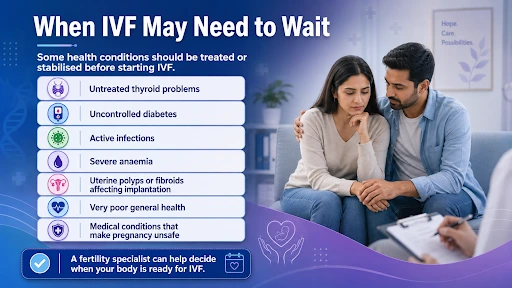
Before IVF, doctors usually recommend a few tests for both partners.
For the female partner:
For the male partner:
If you are consulting a clinic offering IVF services in Kolkata, Petals Health can guide you through these tests and help you understand whether IVF, IUI, ovulation induction, or another fertility option is more suitable.
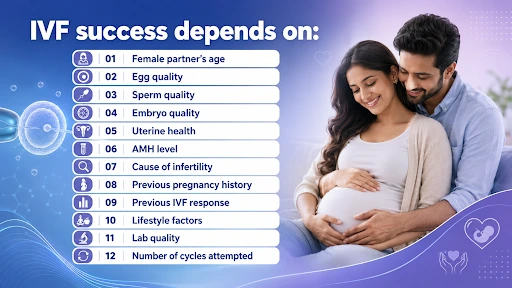
ART success rates vary based on age, diagnosis, previous pregnancy, and treatment details. Average success rates do not predict the exact outcome for one couple.
Age affects egg quality.
You may look young, feel young, and have the energy of five people. But ovaries follow their own calendar. After 35, fertility usually starts declining faster. After 38, doctors often recommend acting sooner.
That does not mean pregnancy is impossible after 35. Many women conceive later. But the treatment plan must be realistic.
In IVF, egg quality is often more important than egg number.
The doctor checks both partners’ history and reports.
The female partner takes hormone injections so the ovaries can produce multiple eggs. You will need regular ultrasound monitoring. This helps doctors track follicle growth.
Once the eggs are ready, a trigger injection is given to help final maturation.
Step 4: Egg Retrieval
Eggs are collected through a minor procedure, usually under sedation.
A sperm sample is collected and prepared in the lab.
The egg and sperm are fertilised in the lab. In some cases, ICSI is used, where a single sperm is injected into the egg.
The embryos are watched for a few days. The embryology lab plays a major role here.
One selected embryo is placed inside the uterus. This is usually a short procedure and does not require major recovery.
After the waiting period, a blood test confirms whether a pregnancy has occurred.
Possible risks include:
Try to:
IVF may be right for you if you have been trying for a long time, if age is becoming a concern, if there are blocked tubes, severe sperm issues, endometriosis, low ovarian reserve, or repeated failed fertility treatments.
But IVF should never be a rushed decision.
If you are looking for a clinic that provides IVF treatment in Kolkata, Petals Health can help you understand your fertility status, discuss your treatment options, and guide you towards the next step with confidence.
Schedule a consultation today.
IVF may be right if you have blocked tubes, severe sperm issues, low ovarian reserve, endometriosis, repeated IUI failure, or long-term unexplained infertility. A fertility evaluation is needed before deciding.
IVF gives more control over fertilisation and embryo development. IUI is simpler and less intensive. The better option depends on your fertility diagnosis.
Yes, it can. But many couples may need more than one cycle. Success depends on age, egg quality, sperm quality, embryo quality, and uterine health.
Yes. IVF with ICSI may help in cases of low sperm count, poor sperm movement, or other male fertility concerns.
No. Low AMH may mean fewer eggs, but it does not automatically mean IVF will fail. Age, egg quality, sperm quality, and embryo development also matter.
Fitness
Health Clinic
Gynecology
Pregnancy
Diabetes
Health
Paediatrics
Health Tips
Arthritis
Allergy and Asthma
Menstrual Health
general
other
Cardiology
Geriatrics
Gastrointestinal
woman and child care
Infertility
Health Checkup
Cosmetic Gynaecology
Hymenoplasty
dermatology treatments
IVF Treatment
Fertility Treatment
Vaginal Rejuvenation
Vaginal Tightening
Aesthetic Treatment

From the Desk of PDG | Honorary Medical Director
Welcome to Petals Health Clinics, a modern family clinic chain designed around Families.
As your partners in health, we take pride in fostering a warm, family-centred environment where every individual feels heard, respected, and cared for.
Our primary focus is on building and sustaining healthy families. We believe that prevention is the cornerstone of good health, and we are dedicated to helping you take proactive steps toward a vibrant and fulfilling life. Through preventive healthcare, regular disease screenings, early detection, and health education, we strive to empower you with the knowledge and tools to make informed decisions about your well-being.
Whether it’s routine checkups, guidance on managing chronic conditions, or personalized advice on lifestyle and wellness, our team is here to partner with you on every step of your health journey.
Thank you for trusting us to be a part of your family’s health story. Together, we can build a foundation for lasting health and happiness.



 Ask a Doctor
 9147405955


