March 17, 2026 | by Admin

If you’ve struggled with infertility for quite some time, chances are you have already heard two terms everywhere — IUI and IVF. And with every conversation, advice, or online search, the confusion only grows.
Should you start simple with IUI? Is IVF more effective? Are you wasting time choosing the wrong one?
The truth most couples eventually realise: fertility treatment isn’t about picking the “better” option — it’s about choosing the right fit for your situation. That decision is based on age, diagnosis, test results, and even emotional readiness.
Consulting an experienced team at Petals Health, a multi-speciality health clinic in Kolkata specialising in IVF and IUI treatment, can help you understand which path makes the most sense for you.
Read on to understand how doctors actually decide.
IUI (Intrauterine Insemination) is often the first step in fertility treatment.
During this procedure, processed sperm are placed directly into the uterus around ovulation. This shortens the journey sperm needs to travel, improving the chances of fertilisation.
The process is quick, relatively simple, and usually painless — more like a scan appointment than a surgical procedure.
IVF (In Vitro Fertilisation) takes fertilisation outside the body. Eggs are retrieved from the ovaries, fertilised with sperm in a lab, and then the resulting embryo is transferred back into the uterus.
This approach gives doctors more visibility and control over fertilisation and embryo development, which is why IVF is often recommended in more complex cases.
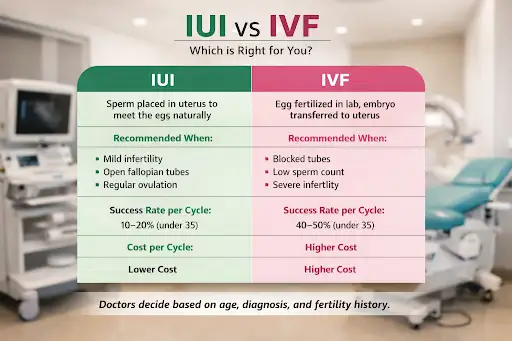
The difference between IUI and IVF can be summed up:
👉 IUI helps fertilisation happen inside the body
👉 IVF helps fertilisation happen in the lab
In IUI, fertilisation still relies on natural interaction between egg and sperm.
In IVF, doctors can directly observe fertilisation and select embryos for transfer.
IVF allows monitoring of egg quality, fertilisation success, and embryo development. This added control can be crucial in cases where natural fertilisation may be challenging.
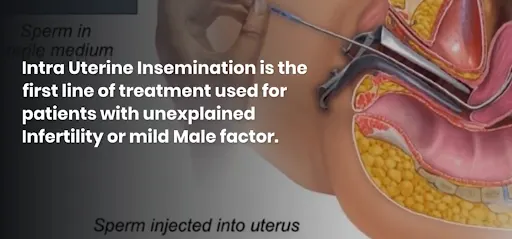
IUI is often suggested as the first treatment when basic fertility factors look favourable.
When tests appear normal, but conception isn’t happening, IUI can give a gentle boost without moving to invasive treatment immediately.
Slightly low sperm count or motility issues may benefit from sperm preparation and targeted placement via IUI.
If ovulation is irregular, doctors may combine medication with IUI to improve timing and egg release.
Many couples undergoing IUI treatment appreciate its simplicity, affordability, and minimal invasiveness as a starting option.
Some situations reduce the effectiveness of IUI, making IVF a more practical first step.
If sperm and egg cannot meet due to blocked tubes, IVF bypasses this obstacle completely.
When sperm count or motility is significantly reduced, IVF with advanced techniques can improve fertilisation chances.
When more than one factor is involved, IVF allows targeted treatment rather than trial-and-error cycles.
With increasing age, time becomes critical. Doctors may recommend IVF earlier to maximise success rates.
Egg quality and quantity decline with age. Tests like AMH help doctors understand ovarian reserve and guide treatment choice.
If you’ve been trying for years or experienced losses, IVF may provide clearer answers and better control.
These results often determine whether IUI is feasible or IVF is more appropriate.
Treatment isn’t only medical — it’s emotional and financial. Good fertility specialists consider your comfort, stress levels, and budget when recommending a plan.
Schedule a consultation at Petals Health, a multi-speciality health clinic in Kolkata, providing IUI and IVF treatment.
IUI success relies on natural fertilisation, so chances per cycle are modest. The IUI success rate by age typically declines after 35.
IVF offers higher success rates because fertilisation and embryo development are monitored. However, the IVF success rate by age still varies significantly.
Doctors often reassess the plan after multiple unsuccessful IUIs. This is when conversations about how many IUI cycles before IVF become relevant.
An IUI cycle usually includes ovulation monitoring, medication if needed, and the insemination procedure. The timeline is similar to a menstrual cycle.
IVF involves ovarian stimulation, egg retrieval, fertilisation, and embryo transfer. A complete cycle may take 4–6 weeks.
Both treatments may involve additional expenses like medications, blood tests, and ultrasound scans — something couples should discuss upfront.
IUI is generally low-risk. Mild cramping may occur, and medication can slightly increase the chance of twins.
IVF involves injections and minor procedures. Rarely, ovarian hyperstimulation syndrome (OHSS) may occur, but careful monitoring reduces this risk.
After 3–4 unsuccessful cycles, doctors often review the diagnosis and discuss IVF as the next step.
A failed IUI doesn’t mean treatment was wrong — it may highlight hidden factors needing deeper evaluation.
Moving to IVF after failed IUI allows direct fertilisation monitoring, embryo selection, and improved implantation chances.
| Factor | IUI | IVF |
| Fertilisation | Inside body | In lab |
| Invasiveness | Minimal | Moderate |
| Timeline | One cycle | 4–6 weeks |
| Success range | Lower per cycle | Higher per cycle |
| Suitability | Mild infertility | Complex infertility |
“What’s the diagnosis we’re treating?”
Understanding the cause helps you trust the recommended treatment.
“What’s Plan A for 3 months—and Plan B if it doesn’t work?”
This keeps expectations realistic and structured.
“How will you monitor ovulation/embryo transfer timing?”
Monitoring quality often influences treatment success.
For some couples, IUI offers a gentle and effective starting point. For others, IVF provides the clarity and control needed for success.
A consultation at Petals Health, a multi-speciality health clinic in Kolkata, renowned for IUI and IVF treatment, can help you move beyond confusion. This is because fertility care works best when it’s personalised.
If you’re unsure whether to begin with IUI or move toward IVF, don’t let confusion delay your next step.
Book an appointment today.
Neither is universally better — the right choice depends on age, diagnosis, and fertility factors.
Most doctors reassess after 3–4 cycles if pregnancy hasn’t occurred.
IUI is simpler and less invasive. IVF involves injections and minor procedures but is generally manageable.
Yes. Many couples conceive with IVF after unsuccessful IUI cycles.
Fitness
Health Clinic
Gynecology
Pregnancy
Diabetes
Health
Health Tips
Arthritis
Allergy and Asthma
Menstrual Health
general
other
Cardiology
Geriatrics
Gastrointestinal
woman and child care
Infertility
Health Checkup
Cosmetic Gynaecology
Hymenoplasty
dermatology treatments
IVF Treatment
Fertility Treatment
Vaginal Rejuvenation

From the Desk of PDG | Honorary Medical Director
Welcome to Petals Health Clinics, a modern family clinic chain designed around Families.
As your partners in health, we take pride in fostering a warm, family-centred environment where every individual feels heard, respected, and cared for.
Our primary focus is on building and sustaining healthy families. We believe that prevention is the cornerstone of good health, and we are dedicated to helping you take proactive steps toward a vibrant and fulfilling life. Through preventive healthcare, regular disease screenings, early detection, and health education, we strive to empower you with the knowledge and tools to make informed decisions about your well-being.
Whether it’s routine checkups, guidance on managing chronic conditions, or personalized advice on lifestyle and wellness, our team is here to partner with you on every step of your health journey.
Thank you for trusting us to be a part of your family’s health story. Together, we can build a foundation for lasting health and happiness.



 Ask a Doctor
 9147405955


